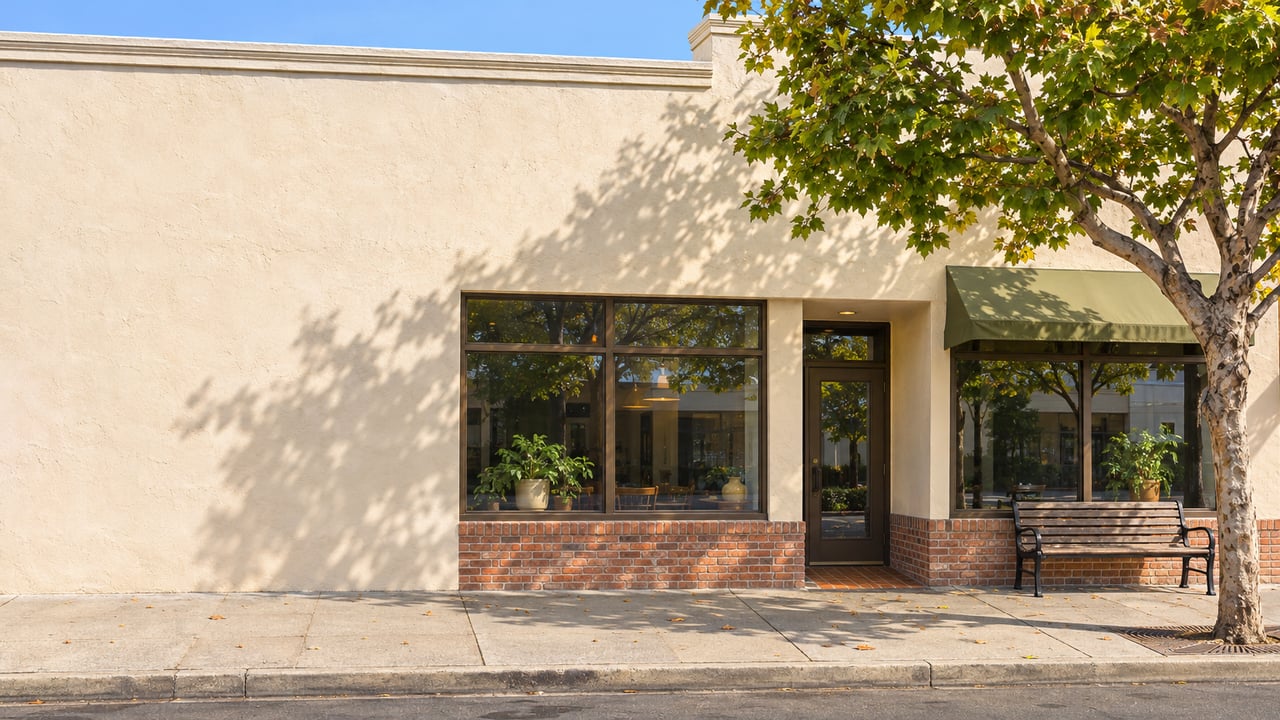
Old Town Placentia's Makeover Has a Price. Here's What It's Waiting On
Placentia adopted its Old Town Revitalization Plan in 2017. Why does Santa Fe Avenue still look so much like it did then? The Old Town Streetscape Improvement Project now has a total project delivery cost of $9,978,105. It still needs a decision on borrowing against future property-tax growth inside the city's infrastructure financing district to pay for it. On October 6, the City Council voted 5-0 to send that decision back for review.
That puts Old Town's next few years on a financing calendar. Private owners aren't waiting for it. The clearest example is the corner of Santa Fe Avenue and Main Street, where a two-story food hall and bar won approval in June.
The rough pavement has a reason behind it, and it explains the timing of everything since. Council Member Jeremy Yamaguchi described it at an April 2025 council meeting, as Voice of OC reported: "we had a lot of work to do in those streets and we didn't want to pave them if we're going to cut them up again." He listed power, internet and sewer lines as the work going in underneath. He said the long-term plan was to finish the underground work first and then "pave it and make it look nice."
The merchants had already been pushing for the street work. On February 12, 2025, Broken Timbers Brewing Company hosted a meeting where Old Town merchants, business owners, neighbors and residents heard from the city about the Old Town Streetscape Master Plan. The plan calls for new street lighting, bike racks, more trees and changes to the pavement. Broken Timbers sits at 116 W. Santa Fe Avenue. Its owner, Heidi Mahnke, told the council, "We have one of the last old towns in Orange County that hasn't been updated," according to the same Voice of OC article.
Here is how the timeline has run since the plan was adopted:
The streetscape is supposed to be paid for through the Placentia Enhanced Infrastructure Financing District, or EIFD. The district works by setting aside part of the growth in property taxes inside its boundary. Property tax on value up to the base-year roll keeps flowing to the city's General Fund. A share of the tax on value above that line goes to infrastructure instead. When the district ends, that money returns to the General Fund.
These figures come from the city's October 6 agenda report:
| Piece of the plan | Figure in the October 6 staff report |
|---|---|
| Old Town Streetscape total project delivery cost | $9,978,105 |
| Projected net bond proceeds over the district's roughly 40-year term | About $10.05 million |
| City's contribution | Half its share of the tax increment, about 6.8 of 13.6 cents on the dollar, capped at $24 million |
| Estimated actual city allocation | $17 million to $24 million, depending mostly on interest rates |
| County's contribution | Half its share, about 2.95 of 5.9 cents, capped at $3,547,000 over the first 25 years |
| Design funding directed in May 2025 | $150,000 |
The first two rows nearly match. The streetscape costs $9,978,105 and the bond is projected to net about $10.05 million, so the district's borrowing capacity has almost no room beyond this one project. That is why the bond terms matter so much. The staff report says the city's contribution depends primarily on interest rates. A higher rate means more of the tax increment goes to debt service for the same street.
The County approved a structure in which the city lends $1 million up front. According to the staff report, that loan would shrink the bond issue, reduce debt service and lower the interest rate. The city would issue its own 30-year Lease Revenue Bonds and put up city property as collateral. Any final debt issuance would come back to the Council for a separate vote.
In May 2025, the Council chose to delay bond financing until the district had built up $1 million or other funding came through. Once that happened, staff would return with construction bids and a financing plan.
That rule brought the item back this fall. According to the October 6 minutes, Council Member Kirwin asked to revisit it after learning that the $1 million requirement had been created by the city rather than the County. He said he had voted under a misunderstanding. City Attorney Bettenhausen explained that removing the threshold would not authorize bond financing. It would only remove the limit.
The discussion that followed covered the condition of infrastructure in the district, Old Town's needs, project scope, cost escalation, Metrolink ridership trends and the effect on the General Fund. Mayor Pro Tem Yamaguchi then offered an alternative motion that kept the threshold in place. Kirwin seconded it, and it passed 5-0:
"to direct staff and the Citizens' Oversight Committee to meet and review the EIFD's financial information and report back to the City Council."
The motion said the review would include current bond rates. With the bond sized this closely to the project, the oversight committee's report back to the Council is the next real step. Construction bids come after the financing plan, so any start date for the street work depends on that report.
The building at 202 W. Santa Fe Avenue, on the southwest corner of Main Street, is not waiting on the streetscape. The 2024 approval added a second story and brought the building to about 11,000 square feet, with roughly 5,500 on each floor. The June 9, 2026 Planning Commission packet describes two concepts. Placentia Exchange is a ground-floor food hall and restaurant with multiple food service operators. The Loft at Main & Rail is a second-floor restaurant, bar and gathering space. The state's CEQAnet record shows the project's Notice of Exemption posted June 10, 2026.
The conditions of approval show what the city expects this corner to be:
The packet ties the project to the city's economic development goal. It describes the venue as adaptive reuse in Old Town's historic core, inside the Main Street four-story subarea of the Old Town Zoning District. Councilman Chad Wanke made a similar point at the April 2025 meeting covered by Voice of OC. He said that "when property owners take responsibility and renovate the buildings, that's what revitalizes an area."
The Planning Commission approved the venue on June 9, four months before the Council took up the financing for the street in front of it.
The third project, the Metrolink station, has been part of Old Town's plans the longest. Voice of OC reported that OCTA approved the station in 2016. In the same article, an Old Town property owner said he bought there expecting the revitalization plan and a new station and parking structure to bring significant change.
OCTA's project page for the Placentia Metrolink Station and Parking Structure puts the site at Melrose and Crowther and the total cost at $34.82 million. The funding comes from OC Go, federal, state and local sources, and excess revenue from the 91 Express Lanes. The page still describes the station as planned, alongside a shared-use, multi-story parking structure. The station is part of the same equation as the streetscape. Metrolink ridership trends came up at the October 6 meeting as the Council weighed the Old Town project.
Here is where Old Town stands after the October 6 vote. The streetscape is priced at $9,978,105, and its financing is with the Citizens' Oversight Committee for review. The food hall at 202 W. Santa Fe Avenue has its approvals. OCTA lists the station at Melrose and Crowther as a $34.82 million project.
If you own a home near Old Town and want to know how the corner at Santa Fe and Main and the pending street work factor into what buyers see today, the Brad Kerr Team can walk you through it using recent local sales. Request a free home valuation, and we'll give you a straight read on where your property stands now.
We provide the expertise, resources, and cutting-edge tools you need to navigate the real estate market with confidence. Whether you're buying or selling, we offer insights and solutions that set us apart. Stay informed about the latest market trends and let us guide you every step of the way.
Brad Kerr Team
BRAD KERR | CA DRE# 01182768
[email protected]
(714) 366-0990
3261 N HARBOR BLVD FULLERTON CA 92835